String instrument remover
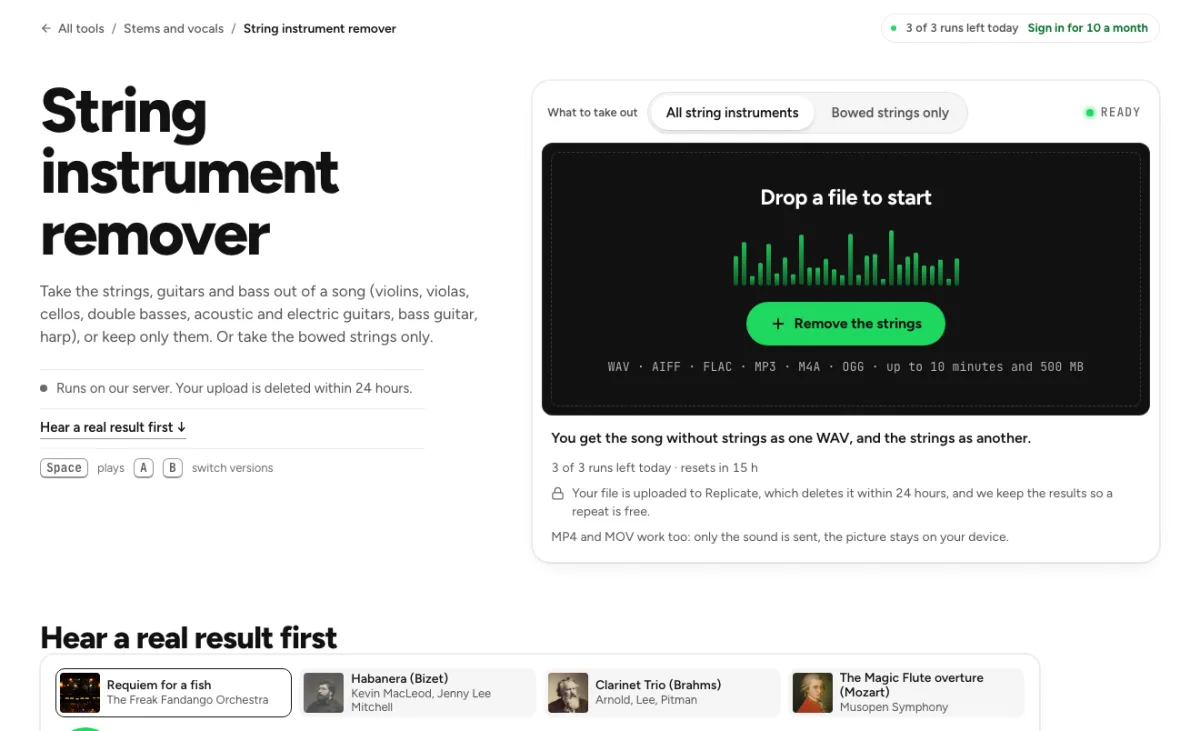
Take the strings, guitars and bass out of a song (violins, violas, cellos, double basses, acoustic and electric guitars, bass guitar, harp), or keep only them. Or take the bowed strings only.
- Runs on our server. Your upload is deleted within 24 hours.
- Space plays AB switch versions
You get the song without strings as one WAV, and the strings as another.
WAV · AIFF · FLAC · MP3 · M4A · OGG · up to 10 minutes and 500 MB
Checking your runs
Your file is processed on a cloud GPU by our processing partner and deleted there within 24 hours. We keep the results for 24 hours, keyed by the file's checksum, so a repeat in that time is free.
MP4 and MOV work too: only the sound is sent, the picture stays on your device.
How it works
- What it does
- Takes the string instruments out of a song: violins, violas, cellos, double basses, acoustic and electric guitars, the bass guitar, and harp. The piano and everything else stay. You get the song without them and the strings on their own, and the two add back up to your original exactly. Choose Bowed strings only to keep the guitars and the bass in.
- Model
- A model that knows 53 instruments runs on our own cloud GPU and finds the instrument in one pass; the instrument and the rest add back up to your original exactly, as 32-bit float so nothing is clipped. Measured on recordings with known parts (SDR): violin 0.9 to 7.6 dB (4.0 on average), string instruments with guitars and bass 10.8 dB on average, winds 10.6 dB on average (5.9 to 8.6 with the room's sound). Model names and licences
- Measured
- Measured on 18 recordings with known parts: seven orchestra passages, nine band and pop songs with a bass guitar (four of them with strings), and two folk passages. Strings, guitars and bass came out at 10.8 dB SDR on average (1.0 to 15.4 dB), where the mix itself, offered as the part, scores -8.0 to +3.0 dB, and the song without them measured 11.6 dB on average (3.6 dB lowest). Before the bass guitar counted, the same recordings measured 4.7 and 5.5 dB, because the bass stayed in. In a full orchestra, where the strings are most of the sound, part of them stays in the song: there the song without strings measured 3.6 to 15.2 dB.
- Output
- Both files are 32-bit float WAV at your file's sample rate. A loud song's instrument or rest can peak above full scale; float keeps those peaks instead of clipping them, so the two add back up to your original exactly. Turn a file down before you export it as 16- or 24-bit.
- Your file
- Your file is processed on a cloud GPU by our processing partner and deleted there within 24 hours. We keep the results for 24 hours, keyed by the file's checksum, so a repeat in that time is free.
A song without its strings
Strings, guitars and bass together
Violins, violas, cellos, double basses, acoustic and electric guitars, the bass guitar and harp come out in one pass. On 18 recordings with known parts they measured 1.0 to 15.4 dB SDR, 10.8 dB on average, and the song without them 11.6 dB on average. On nine band and pop songs with a bass guitar the song without them measured 11.6 to 19.4 dB. In a full orchestra, where the strings are most of the sound, part of them stays. The string instrument remover has two scopes. The broader choice includes bowed strings, guitars, bass guitar and harp. Bowed strings only targets violins, violas, cellos and double basses while preserving guitars. Decide which musical family you mean before processing; a guitarist and an orchestral arranger may need opposite choices.

Or the bowed strings only
Choose Bowed strings only to keep the guitars and the bass guitar: then only violins, violas, cellos and double basses are taken. On five band songs with guitars and no bowed strings, what it took out sat 53 dB or more under the song, so a band without strings comes back as it went in. Choose bowed strings only when the objective is removing an orchestral layer while keeping the band's guitars. This setting is not a way to isolate one violin section or one cello desk. The model groups bowed-string material, and closely related instruments can remain blended together rather than becoming individual session tracks.

Nothing thrown away
You get the song without strings and the strings on their own, both as 32-bit float WAV. Nothing is clipped, and the two add back up to your original exactly. The selected group and the music without it are supplied as complementary floating-point WAV files. This supports checking and later rebalancing, but it does not guarantee a completely clean string stem. In a full orchestra, much of the recording is shared strings and room sound, which makes the boundary harder than a clear string pad behind a band.
Who takes the strings out

String players
Play your part with the rest of the arrangement, or hear the section on its own. String players can rehearse a part over an accompaniment with less recorded string material competing. Check whether the broad setting has also removed guitar or bass that you wanted to follow. Keep a note of the chosen scope with the downloaded track so a rehearsal group understands which instruments are deliberately absent.
Arrangers
Take a string arrangement out of a song to write a new one over the band. An arranger can compare the song with and without its string texture before drafting a new voicing. Focus on the harmony and register rather than assuming every extracted note is correct.
Producers
A drier version of a track without its string pad, or the strings alone for a remix. A producer can audition a drier arrangement or use the extracted texture as a reference for a new part. If the goal is preserving guitar and bass, start with bowed strings only.
How to remove strings from a song
Drop the file
WAV, MP3, FLAC, M4A or a video. Files up to 10 minutes, 25 on Pro. Identify the arrangement before selecting a setting. A pop song with acoustic guitar and no orchestral strings needs a different choice from a full symphonic passage. Use a clear source and select a representative section with the instruments you care about, then check the displayed duration and allowance before starting.
Wait about a minute
A 4-minute song takes about a minute, plus up to a minute when the model has to start. The same file again comes back at once. After the run, listen to the extracted strings and the remaining ensemble at the same position. Check low strings, plucked attacks and reverb tails as well as the most obvious high violin line.
Compare and download
Switch between Before and After on one playhead; the strings are marked on the Before picture. Download the song without strings, the strings, or both. Download both files while the result is available and preserve their timing for further editing. Judge the accompaniment while rehearsing or arranging, and the extracted strings if they will be exposed alone. Use a separate delivery copy when changing levels, format or loudness so the original separation remains available for comparison.
Questions about removing strings
Will some strings stay in the song?
Some can, and how much depends on the music. Behind a band or a singer most of them come out: on nine band and pop songs the song without strings, guitars and bass measured 11.6 to 19.4 dB SDR. In a full orchestra, where the strings are most of the sound, only part of them comes out: on three passages of two orchestra recordings made with the room's sound the song without strings measured 3.6 to 8.0 dB. Harp comes out only partly: on two orchestra passages with a harp, the harp file was about 9 dB quieter than the real harp. Listen before you use it. Judge the result against your arrangement and intended use. Dense orchestral passages can be helpful for study without being clean enough for a newly exposed backing, while a clear pop string pad may separate more usefully.
What counts as a string instrument here?
Violins, violas, cellos, double basses, acoustic and electric guitars, the bass guitar, and harp. The piano, drums, voices and winds stay. Where two of the model's parts hold the same sound, such as the cellos and double basses of an orchestra, which its string and bass parts both pick up, that sound is taken out once, not twice. The model's banjo, mandolin, ukulele, dobro and sitar parts are not used: in our tests they took bowed strings instead, for example a solo cello. If you only want the violins, violas, cellos and basses out, choose Bowed strings only. Select the narrow or broad group before processing, then inspect what remains. The setting defines the intended instruments; it does not guarantee that every note is cleanly assigned in a difficult ensemble recording.
What happens to my file?
The audio is sent to cloud processing infrastructure, including Replicate, rather than being separated wholly on your device. Results may be held temporarily to serve downloads and identical cached requests. Save the output you need and consult the Privacy Policy for current retention and handling details; this result page should not be treated as long-term storage. Download both complementary results and retain the source. Use a separate delivery export when changing gain or format so the original floating-point pair remains available for checking and future edits.
What should I check after using this string instrument remover workflow?
Listen to the chosen string-instrument group and remaining ensemble, rather than judging just one file. The difficult cases include orchestral overlap, incomplete harp extraction and the scope of the selected group. Compare an exposed passage, a busy section and the tail of a sustained sound at the same musical moment. A result can work for practice while being too rough for an isolated production use. Choose based on the sound you will actually deliver, and keep the original nearby when a note, word or effect is uncertain.
What source recording should I use?
Start with the cleanest version you already have and avoid repeated lossy conversions. Saving a damaged recording as WAV does not restore the detail it lost. Excessive EQ, clipping or added reverb before separation can make the task harder. Keep the original and work on a copy so later comparisons remain meaningful. The everyday phrase string instrument is broader than an orchestra's string section. Guitar, bass guitar and harp can all be part of the wider choice here. When planning a rehearsal backing, write down the instruments that must remain, then select the setting that respects that list before you upload.
How do file length, plan access and cloud runs work?
Targeted separation allows up to 10 minutes without a paid plan and 25 minutes on Pro; the chosen mode and uploader show the applicable limit. The current catalog allows 3 runs daily anonymously, 10 monthly for signed-in free users, 80 monthly on Pro and 150 on Pro+. Each new file and processing configuration uses the relevant allowance; an identical result can be free while cached. Check the current pricing and the uploader before processing a batch. Downloads are part of the result, not a separate per-file unlock.
Is this separation performed entirely on my device?
No. This is cloud separation: audio is uploaded for processing on external infrastructure. Browser playback, comparison and some exports happen locally after the results arrive, which does not make the separation itself offline. Check the Privacy Policy before submitting sensitive material, and use an appropriate local workflow if audio must stay entirely on your device. Download useful outputs while available; temporary results and cached repeats are not a permanent archive.
Can I publish or share the separated result?
Separation changes the balance of a recording, not its ownership or the permissions attached to it. Use material you own or are otherwise entitled to adapt, and arrange the permissions needed for your intended publication. A separated result does not include a licence to a commercial song, performance or soundtrack. For your own project, keep the source, an untouched separation and a separate delivery copy. Listen again in the complete mix before sharing; an acceptable rehearsal reference may reveal artefacts when exposed alone.
Learn how
Guides and tutorials that use this tool, with real screens and real numbers.